
The pair recalled wandering around campus during their freshman year trying to find the room where JVP was hosting a Shabbat meal and running into a group of students carrying a challah.
“We were like, ‘Is this JVP Shabbat?’” Frieman said, “and they looked at us —”
“— death glare,” Krumholz interjected.
“They looked at us like we were insane,” Frieman added.

The pressure on students who support Israel and Zionism can be more subtle. When Elizabeth Irwin started at GW, she was eager to get involved in feminist activism on campus. Then she — like Flayton before her — found that many progressive groups were hostile to Israel or, like the College Democrats at the time, remained silent so they could work with organizations that supported boycotting the Jewish state.
While she was never excluded from these organizations, Irwin lost interest in participating. Instead, she spent two years in leadership roles with GW for Israel.
“I was like, ‘OK these aren’t really spaces for me,’” said Irwin, who graduated last spring. “It just changed my trajectory of what I thought I’d do in college.”
The polarized nature of Israel on campus makes it hard to find a middle ground between GW for Israel’s proud support for Zionism and Jewish Voice for Peace’s staunch opposition. J Street U tries to split the difference, but its members say they still encounter vitriol.
The group has hosted fundraisers and lectures with GW for Israel, but its politics are different; the J Street chapter criticizes the Israeli “occupation” of the West Bank, for example, while GW for Israel has called that term “misleading.”
Alicia Glassman helps run J Street U on campus and said that while many are drawn to GW for Israel for its cultural events and free food, her club better reflects most Jewish students’ politics — supportive of a Jewish state, but critical of Israel’s oppression of Palestinians.
“I would not say GW for Israel is the primary position of people — even within their organization,” Glassman said.
At a J Street U event about American military aid to Israel last fall, several members mentioned how refreshing it was to discuss the conflict without pointing fingers.
“I feel like Zionism and anti-Zionism are words that are thrown around a lot,” noted Eliana Pierotti, who taught Hebrew school during high school and is majoring in public health. “I try not to take one single difference and then use that as an excuse to not learn more.”
J Street shares a Hillel staff adviser with GW for Israel and hosts its events at the Hillel building. And Jeremy Ben-Ami, J Street’s president, last month defined the group as “Zionist” and “anti-BDS,” referring to the boycott movement against Israel. But that hasn’t stopped its members from facing the same kind of harassment that members of Jewish Voice for Peace report.
“Sometimes the line is just drawn so fast,” said Hyatt Aronoff, a co-chair of the GW chapter. “People will be like, ‘J Street — you’re literally antisemitic.’ It’s like, ‘OK, what?’”
These clashes among young Jews are rarely acknowledged by outside organizations, which tend to depict a campus battle between Jews and virulent antisemites. The American Jewish Committee, for example, dubbed the flurry of social media posts and student government resolutions targeting Israel during its military campaign in Gaza last year as examples of “Jew-hate on campus.”
Students tend to see these internal divisions more clearly, and notice how they have trickled down to affect Jewish life on campus broadly.
By all appearances, the vigil held following the Torah vandalism last year was an apolitical event. There were no protesters there to harangue the students carrying the replica Torah, still covered in blue liquid laundry soap. A campus rabbi hung a mezuzah at the ransacked fraternity, then another at a Jewish sorority, and nearly 500 students crowded the streets and sidewalks chanting “Am Yisrael Chai,” a popular Jewish cheer and patriotic, if charged, slogan in Israel that translates to: “the people of Israel live.”
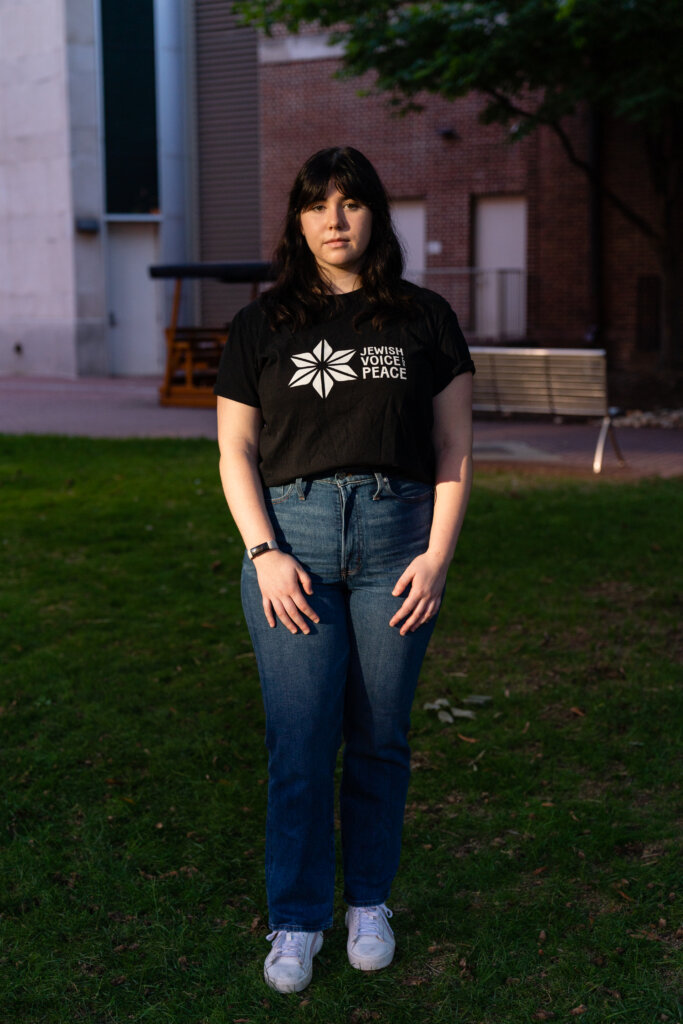
Yet Frieman, the co-president of Jewish Voice for Peace, said her organization was shut out of the event. Years of being called an antisemite by other Jews, she added, made it hard to feel connected to the community and to emotionally process incidents like the Torah vandalism.
“I don’t ever have a sense of solidarity when those things come about,” Frieman said. “That just sucks.”
These concerns receive short shrift from the Jewish establishment. Jonathan Greenblatt, the ADL’s chief executive, mocked Jewish Voice for Peace in a May speech, and called its members extremists who embolden people to “slur” Jews, vandalize synagogues, beat up Orthodox Jews and even commit murder.
“Neither their identity nor their intent relieves them of responsibility for their actions,” Greenblatt said.
The students whom Greenblatt and other national Jewish leaders pledge to protect take a more nuanced view. GW for Israel’s leaders were critical of JVP, noting they serve non-kosher food at Shabbat dinners, and questioning whether all of the group’s members — a relatively small number, they are also quick to note — are Jewish. But they also understood that many of their Jewish peers do not share their particular brand of Zionism.
“I grew up assuming everyone who was Jewish was pro-Israel, and then I came here,” said Stone, the club’s education director. “Being Jewish here is a really large spectrum; you never really know what you’re getting.”


